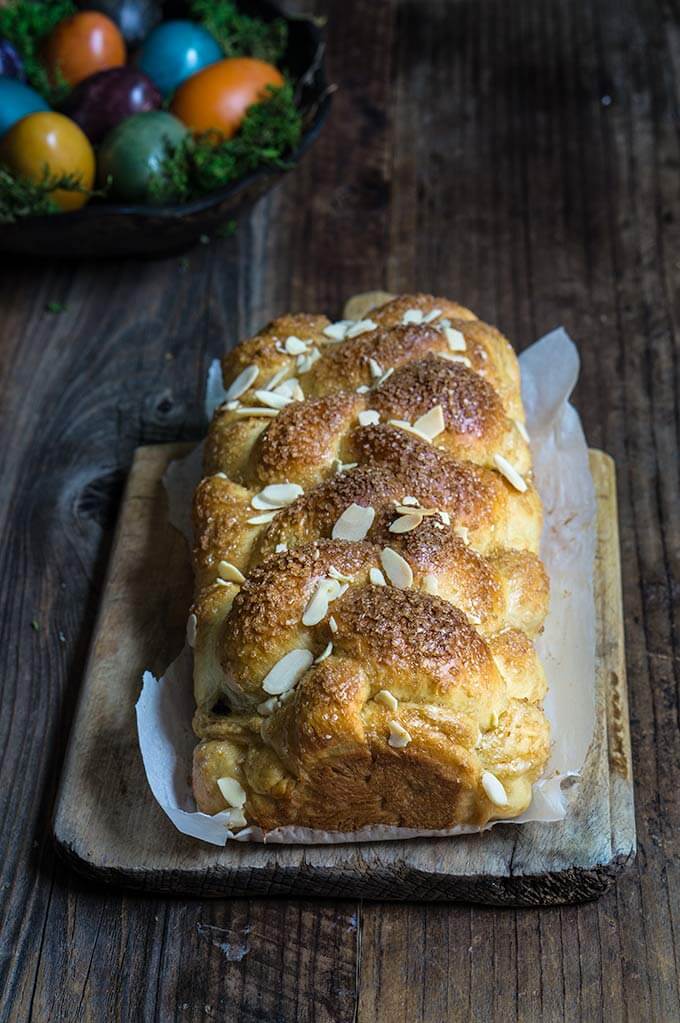
Bulgarian Easter bread, a.k.a. kozunak, is a traditional, sweet yeast bread – cotton-soft, sugar-crusted, studded with rum-soaked raisins, and perfumed with vanilla and lemon zest – incredibly delicious on its own, it’s the ultimate Easter treat.

Growing up in the Eastern Orthodox Christian tradition, Easter for us didn’t mean egg hunts for chocolate-filled, pastel-colored plastic eggs, and certainly wasn’t associated with bunnies, and carrots. Instead of egg hunts we had egg fights, and instead of chocolate, we stuffed ourselves with loaves of soft, sweet Easter bread, or kozunak as we call it.
According to tradition, the eggs were supposed to be dyed on Holy Thursday only, and only in bright red color. At some point, the Bulgarians slightly veered from tradition, and allowed other colors as well, and it became a competition of whose eggs will be the brightest, the pretties, and the most artsy. We all got so creative with our dying techniques that after spending hours, painstakingly turning each egg into a masterpiece, every family’s Easter eggs stash would be a magnificent display of bright colors and patterns, worthy of an art exhibit. Every year we would try something new and interesting – we would use white wax to draw geometric patterns on the eggs, before dipping them in the dye and revealing our creations; we would go on a hunt for various plants and flowers to use as stencils; we would add a few drops of oil to the dye to make a beautiful marble effect; we would use tie-dye techniques or add salts to achieve a crystal-covered shell effect.
And then, after all this labor of love, we couldn’t wait to smash those beautiful eggs in the fun, competitive game of egg fighting that happened on Easter day. Everyone would pick their best ‘fighter egg’ (there were definitely tips on how to choose the strongest egg – like the shape of the egg, or how rough the surface on the tip was), and we would start fighting each other by tapping our eggs against each other’s – pointy end to pointy end, dull end to dull end, until we had a clear winner that survived the fight without a crack. We had a blast! No wonder it was one of the most eagerly anticipated holidays of the year for us kids.
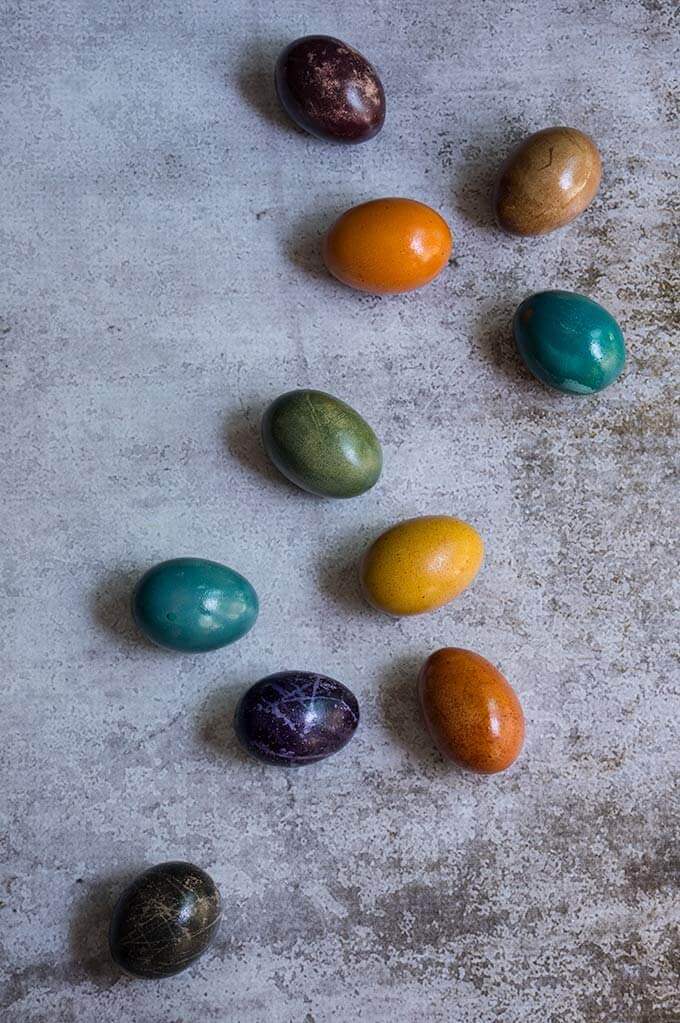
And like every major holiday, our memories of that event are inevitably intertwined with memories of the traditional foods cooked on that day. Besides the classic roasted lamb with rice and greens (which the kids completely ignored), the single, staple Easter food for us was the coveted Easter bread. It was a treat, made only once a year, and it was definitely something worth waiting a whole year for. The sticky, sweet bread, with its warm, fresh, yeasty aroma, studded with rum-soaked raisins, perfumed with vanilla and lemon zest, cotton-soft and so spongy, that when you tear it, it separates into threads of dough – this was Easter bliss!
Just like with the eggs, there was a massive, competitive Easter bread bake-off among the women. After dying the eggs on Thursday, most would spend the whole day on Saturday, or sometimes the night before Easter, making, and baking loaves of kozunak so that they can serve it fresh out of the oven on Easter morning for breakfast, and bring to family gatherings. Baking a good loaf of kozunak was like a batch of honor. Not everyone could pull it off the right way – soft, moist, with a stringy texture – the telltale sign of a great Easter bread. In fact a lot of women didn’t even dare to attempt making it due to its notoriety. But if you accepted the challenge, and baked your own successful bread, you would never look at a store-bought version again, and would gladly sacrifice a whole day, or a sleepless night once a year. It’s one of those super rewarding experiences that cannot be fully explained until you experience the total satisfaction for yourself.
Baking a good loaf of kozunak is like taking care of a baby – it needs lots of love, warmth, and a delicate touch. And before you run away, let me just assure you – with a great foolproof recipe like this one, and a few tips, it can be a painless, and successful event.
This recipe is by far the best that I’ve made. I came upon it on a Bulgarian food blog, and it’s a tried and true family recipe, passed on from generation to generation, that works without a fail. Unfortunately, I was caught up in the Easter festivities, and didn’t have time to post it before the holiday, but it’s such a great recipe, that despite the delay, I’m excited to share it for those who want to try next year, or even do a test batch before Easter.
Traditionally kozunak is made with rum-soaked raisins, but you can use fruit jams and chopped nuts too as a filling too. If you have access to Turkish delight (usually found in Mediterranean stores), that’s another great filling, combined with walnuts. The dough itself is not too sweet, so you can control the sweetness by adding more filling. But be careful – too much jam, and the dough may not properly rise.
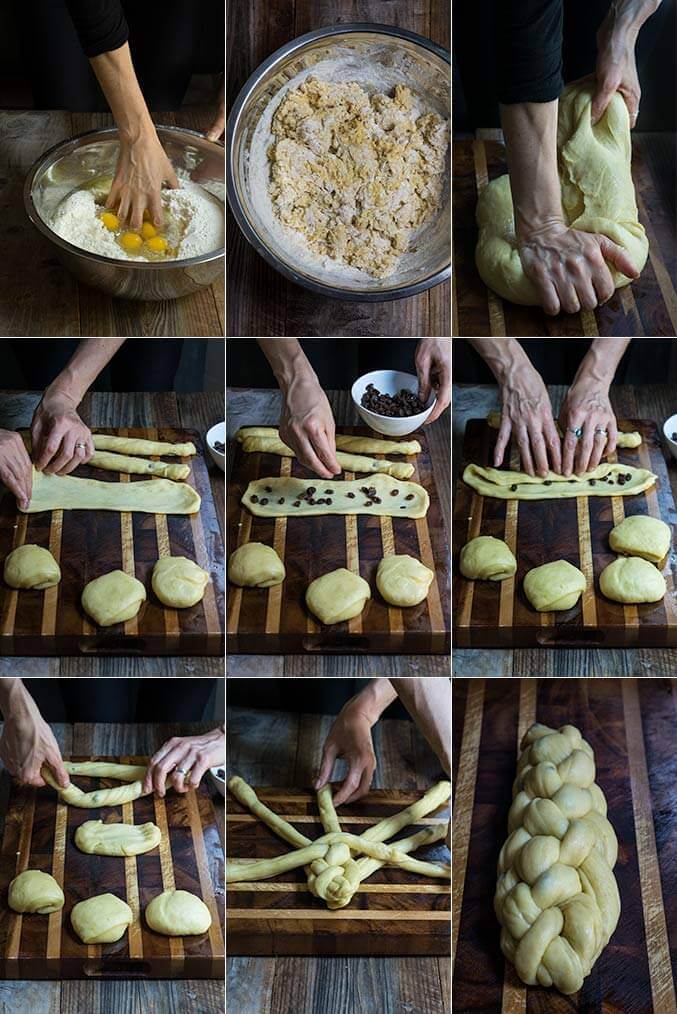
I chose to use a 6-strand braid here, but the more traditional one is the regular 3-strand braid. If you make it in a round shape, just coil the braid into the form. Or, you can check out how to make a round 4-strand braid here. If you decide to do the 6-strand braid, here’s a how-to video.
A few tips and notes before you start:
- Make sure your kitchen is quite warm. I sometimes turn on the oven, and leave the door open so it’s nice and hot.
- You need all your ingredients at room temperature. If you forget to take your eggs out of the fridge beforehand, just place them in warm water to speed up the process.
- Like most yeast breads, this one needs to proof twice before baking. To be on the safe side, make sure your yeast is not close to expiration date.
- Hands on time is probably 40 minutes, but plan to be in your house for the day, to check on the dough. It may take 2-4 hours for the first rising, and another 1-2 for the second.
- If you have a KitchenAid mixer, you can use it for the initial dough mixing. However, when you begin the second stage of kneading while incorporating the oil, it’s important to do it by hand, so as to pull and stretch the dough, while adding the oil. This step is crucial. and will make your kozunak stand out by developing a string-like consistency, which is the hallmark of a great kozunak.
- The trick is to bake the bread in bread pans, or a cake form with high walls, which snugly holds the proofed dough, so it stays nice and high, and remains moist. If baking it on a tray, it will remain relatively flat, and will lose its moisture quicker. In that case, reduce the baking time, and check if done around the 35-40 min. mark, by inserting a wooden stick (toothpicks are not long enough for this).
- The baking time will vary based on the size of your loaves. This recipe will make one big round loaf (using an 11-inch round cake form) in which case baking time may be about 50 minutes, or two smaller ones, each about 800-900g, using regular size bread pans, in which case baking time should be around 40 minutes.
- Use very coarse sugar, like Demerara sugar
, to sprinkle on top, and do so liberally. If you use regular sugar, it will melt into the crust and will not create this sugary, crystal-studded yummy crust, which is one of the best parts!
- This bread should not have a dry crumb consistency. It should be moist, and doughy, and stringy. Definitely do the wooden stick test, but don’t be surprised if it comes out clean, yet your bread feels slightly under-baked afterwords – that’s how it should be.
 , to sprinkle on top, and do so liberally. If you use regular sugar, it will melt into the crust and will not create this sugary, crystal-studded yummy crust, which is one of the best parts!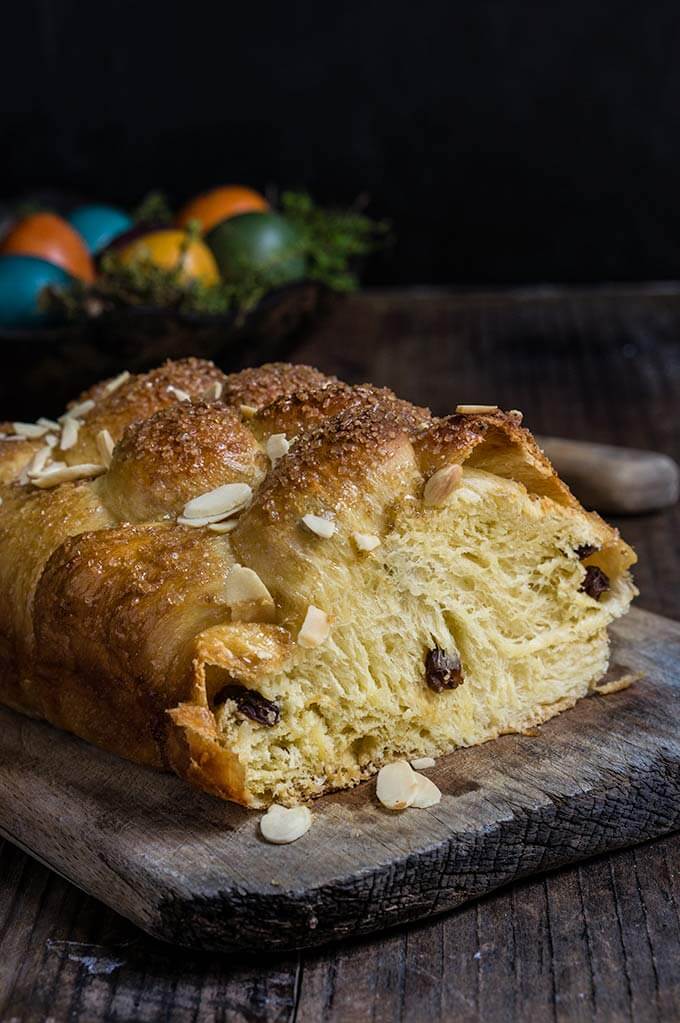
For more Easter inspiration, check out my naturally dyed eggs post.
Happy baking, and make sure you send me your comments and feedback if you make the bread!
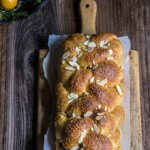
Bulgarian Easter bread - kozunak is a cotton-soft, sugar-crusted sweet bread, studded with rum-soaked raisins, and perfumed with vanilla and lemon zest - the ultimate Easter breakfast.
- 250 ml milk
- 1 cup granulated white sugar
- 200 ml grapeseed / sunflower, or avocado oil (choose a light, neutral-tasting oil)
- 4 eggs
- 2 lbs white flour
- 2 tsp vanilla extract
- 1/2 tsp salt
- zest of 2 lemons
- 14 g instant yeast
- 150 g raisins, soaked in rum
- chopped almonds, for sprinkling on top
- 1/2 cup coarse (Demerara) sugar, for sprinkling on top *
- 1 egg white, for brushing the top
- rum or brandy for soaking the raisins
-
Sift the flour into a big bowl. Take out 1-2 cups, and reserve for later.
-
Add the sugar to the milk, and heat on the stove until the sugar dissolves. Let cool, until quite warm, but not hot. Add half of the oil (100 ml), the yeast, vanilla, lemon zest and salt. Mix well (no need to wait for the yeast to proof first).
-
Make a well in the flour, and pour in the milk-yeast mixture. Add the eggs, and start mixing by hand. The dough will be pretty sticky and shaggy at first. Remove the dough to a well floured surface, and continue to knead for at least 5 minutes, by adding some of the reserved flour, until the dough is no longer sticky, and forms a nice, elastic, medium-soft ball. (Up until this point, you can do this in a KitchenAid mixer, but for the next step, use your hands).
-
Make a dent in the dough, and add some of the reserved oil. Knead by pulling and stretching over and over, until the oil is absorbed. Continue to add the rest of the oil, little by little, until all of it is fully incorporated (I did this in 5-6 intervals). At this point the dough will not be sticky, and there is no need to add more flour. This step will take another 10-15 minutes.
-
Weigh the dough, and divide into two equal portions (if making two loaves), or leave in one whole piece. Place in a lightly oiled bowl, cover tightly with plastic foil, wrap a warm towel around it, and leave in a warm place to proof. The dough should triple in volume during the first proofing. It may take 2-4 hours, or more, depending on how warm your kitchen is. (It took mine 4 hours). **
-
While the dough is proofing, place the raisins in a shallow bowl, and pour enough rum over them to cover them completely. Let soak for at least 30 minutes. Drain well. ***
-
Once the dough has tripled in volume, divide each loaf into 3,4 or 6 equal portions, depending on what braid design you'd like to make. The easiest, and the most traditional is a 3-strand braid. So if making two loaves, that means, divide the dough into 6 equal portions (about 300 g each). Take one portion, and cover the rest with plastic wrap, while you are working on it.
-
Oil your hands, and using a clean flat surface, gently stretch the piece into an oblong shape, about 3-4 mm thick, by tapping lightly with your fingers. Do not use a rolling pin! Spread about 1 Tbs of raisins over it, and roll out to seal the filling. Take both ends of the strand, and twist in opposite directions, so you end up with a twisted rope. Lightly oil the rope, and proceed with the rest of the portions.
-
Braid the ropes into the desired type of braid. Check out this tutorial if you want to make a round-shapeed 4-strand braid, or this one for a 6-strand long braid.
-
Line your baking pan/form with parchment paper, and place the braided loaf in it. Cover tightly with plastic wrap, and a warm towel and leave in a warm place to proof a second time. This time, your dough is done when it roughly doubles in volume.
-
Preheat your oven to 325 °F.
-
Beat the egg white lightly, and brush all over the bread surface.
-
Sprinkle the loaves liberally with the coarse sugar, and chopped almonds.
-
Bake for 40-50 minutes. Monitor the bread, and around 15-20 minutes into baking, cover the top with aluminum foil to prevent the crust from burning. If making two loaves, check if your bread is done after 40 minutes by inserting a long wooden stick. If you are making one big loaf, check for doneness in 50 minutes. It's important to not overbake the bread, so it doesn't lose its moisture.
-
Let it cool off a bit, uncovered to preserve the sugary crust crunchy, and serve on its own with a glass of milk!
* You can find Demerara sugar online.
** Turn your oven on the lowest setting - 100 °F, and once it reaches this temperature, turn if off, and put your loaf in the warmed up oven to proof.
*** Other filling ideas to try:
- Fruit preserves + chopped nuts (use jam sparingly - too much filling will prevent the dough from rising properly the second time)
- Turkish delight, chopped into small pieces + walnuts.
- Mix equal parts cacao powder and brown sugar, and spread evenly over the stretched dough, or use Nutella/chocolate chips.
Calories are calculated assuming each loaf is 8 portions.


[…] GET THE RECIPE […]